
Kimi K3 played move 37.
Denied compute, Moonshot optimised bits instead. Kimi K3 is what that produced, and the reason serious AI is about to run on your own devices.
On 22 July, the director of the White House Office of Science and Technology Policy accused Moonshot AI of obtaining Nvidia GB300 servers in Thailand and using them to train its models. Moonshot has not confirmed or denied it. Nothing has been tested in any court. Nvidia’s share price fell anyway.
Set aside for a moment whether the accusation is true, and look at what it concedes. To build Kimi K3, a Beijing lab either had to route around US export controls or work without the hardware those controls withhold. Either way, the controls bound. They did what they were designed to do.
That is the part almost everybody is getting wrong this month. The export controls worked. Working is what caused the problem.
What the controls actually did
Since 2022, US rules have kept Nvidia’s most advanced chips out of Chinese hands. The regime has tightened and loosened repeatedly since. In January the H200 became conditionally available with a 25 per cent tariff and a volume cap. In late May, Commerce closed the loophole that had allowed Chinese firms to buy through overseas subsidiaries. Analysts estimate that even if H200 sales to China were fully opened, the United States would still produce somewhere between 21 and 49 times more AI compute this year.
The constraint is not theoretical. Kimi K3 launched on 16 July, and Moonshot had to pause new subscriptions within 48 hours because it did not have the capacity to serve the demand.
So the controls worked. What no export control can do is dictate how a lab responds to them.
Faced with a hardware ceiling you have two options. Buy your way past it, which was the option that got closed. Or engineer your way under it. Moonshot engineered.
Washington set the board. Moonshot played the move.
The variable everyone was measuring
In 2016, AlphaGo played a move against Lee Sedol that broke a rule the professional game had followed for a thousand years. The commentators assumed it was an error. It was not. What made move 37 significant was not that it won a game. It was that it proved the way an entire profession judged a position was wrong.
For three years this industry has judged progress by compute. Chips, data centres, power stations. That measure got written into share prices, into capital allocation, and eventually into law. Export controls are that measure expressed as policy: if compute is the thing that produces capability, then denying compute denies capability.
Kimi K3 is the evidence that compute was the wrong variable. The right one is bits.
Where it landed
Artificial Analysis runs an aggregate score across nine separate evaluations. As of 25 July, K3 sits at 57.
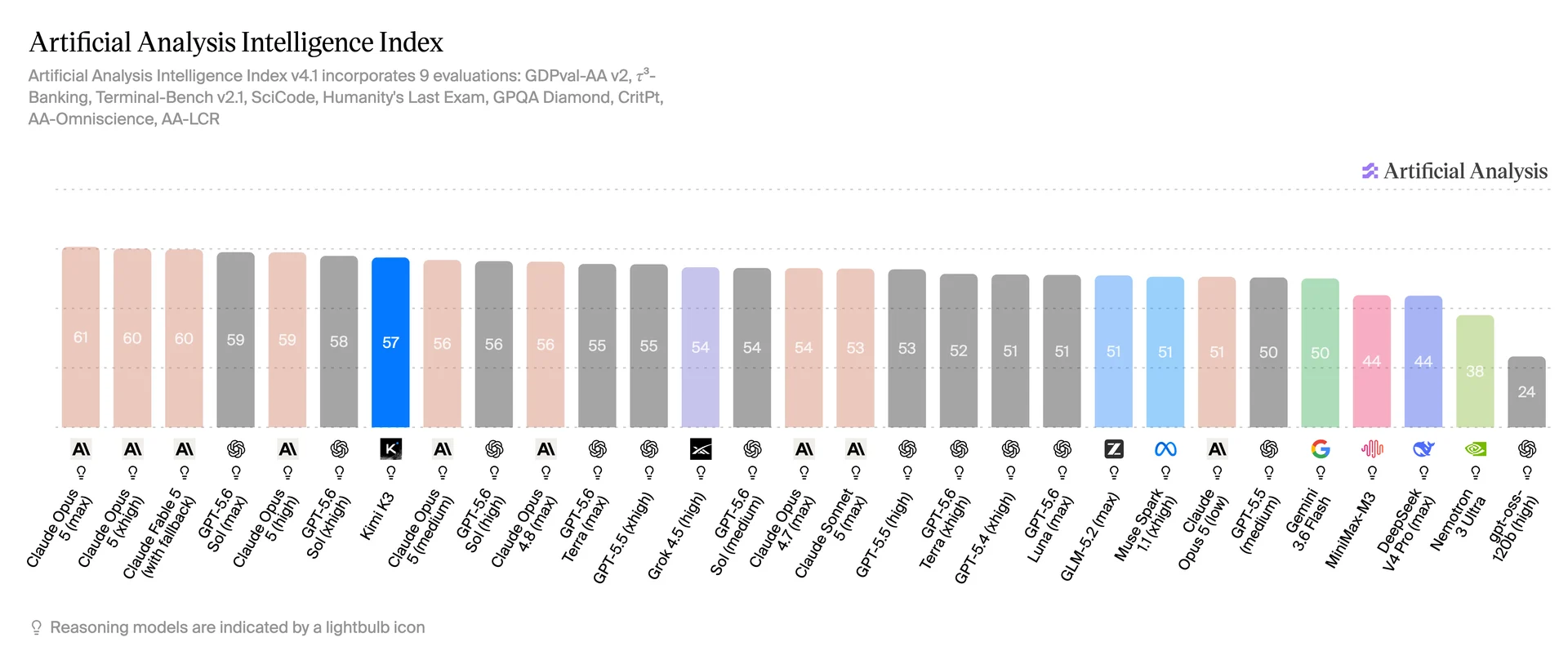
Seventh overall. Four points behind Claude Opus 5 at its highest setting. No open-weights model on that chart is closer to the top — the next one down, GLM-5.2, is six points back, and DeepSeek and MiniMax are thirteen.
Seventh is not first. That is also not the point. The point is that seventh was reached from underneath a hardware ceiling, and then given away.
Four bits
Inside any model there are billions of numbers, and you choose how much space each one is given. Thirty-two bits was the old default. Then sixteen. Some models moved to eight. K3 uses four.
Halve the bits and you halve the memory the model needs in order to exist at all. Going from sixteen down to four makes the whole thing four times smaller. Memory is what decides which hardware a model can run on, so this is the largest single lever available to anyone in the field.
The important detail is not that K3 is four bits. It is that it was trained that way. The normal approach is to finish a model at high precision and compress it afterwards, which costs quality, which is why compression was treated as something you did to small models destined for cheap hardware. Moonshot applied quantisation-aware training from the fine-tuning stage onward, four-bit weights with eight-bit activations, so the model learned to work in that space rather than having precision stripped from it at the end.
That is the move everyone had ruled out. It held.
They applied the same discipline in two other places. K3 activates roughly 2 per cent of itself for any given word, about 50 to 60 billion parameters out of 2.8 trillion. And they rebuilt the attention mechanism so it stops accumulating an enormous running memory of a long conversation, which is the thing that actually breaks long context on constrained hardware.
Three separate answers to a single question: what can we do without.
What it costs to think
A score is half of a purchasing decision. The other half is what it costs to get there, and that is a different chart.
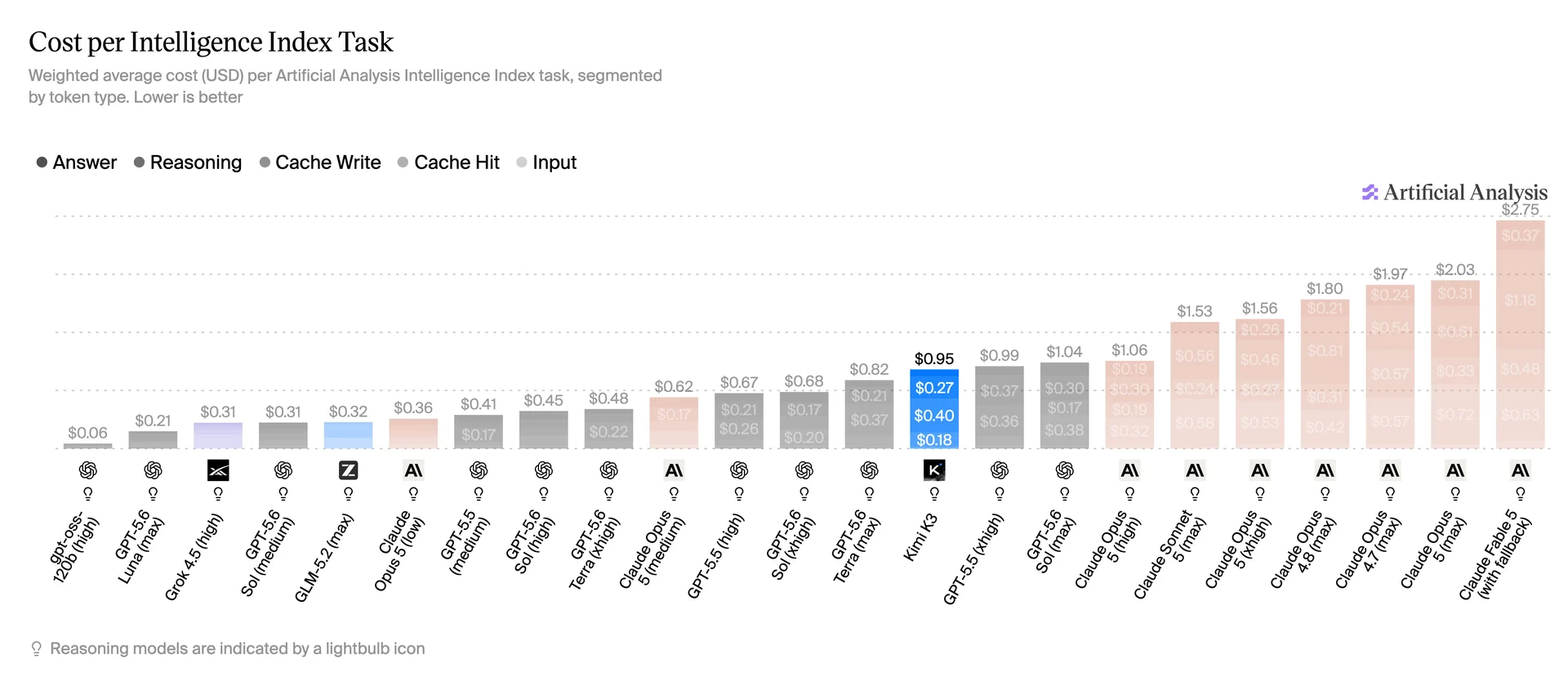
K3 comes in at 95 cents a task. The model above it on score, Claude Opus 5 at max, costs $2.03. Claude Fable 5 with fallback costs $2.75. So K3 returns ninety-three per cent of the leader’s score for under half the price of running it, and that is a real result.
Now the part that does not flatter K3. GPT-5.6 Sol at xhigh scores 58 — one point higher — for 68 cents. K3 is not the cheapest way to buy this level of capability through an API, and it is nowhere near the cheapest thing on the chart; GLM-5.2 does 51 for 32 cents.
That is worth sitting with, because it tells you where the efficiency actually went, and where it did not.
Four-bit weights make a model smaller. Smaller is a statement about memory, and memory decides which machine the thing can live on. It is not the same variable as what a hosted API charges you per task. Moonshot’s own API sits at $3 per million tokens in and $15 per million out, which is American-lab territory.
The per-task number is high because K3 thinks for a long time before it answers, and thinking is billed as output. That is the signature of a model built under a compute ceiling. Training compute you did not have becomes inference compute you do spend. A lab with unlimited chips can push more capability into the weights during training and let the finished model answer quickly; a lab without them claws some of that back at run time, by letting the model reason for longer on every question. The compute bill arrives either way. Scarcity did not remove it. Scarcity moved it — off the training run, where Moonshot could not pay it, and onto inference, where the customer can.
The price is paid in time
The same trade shows up as latency, and here it is unmissable.
Artificial Analysis measures K3 at 32.6 output tokens per second. The median for reasoning models in its price band is 70.9. It produces text at less than half the rate of its peers.
Latency is starker. Time to first answer token — on a reasoning model, how long you sit there between asking and seeing anything that is actually part of the answer — comes in at 161 seconds, against a median of 2.87. That is not a rounding difference. That is a model that goes away and thinks for the better part of three minutes.
Two caveats, both real. Some of that is serving conditions rather than the model itself: K3 launched into demand it could not meet, and these figures are measured against an API that was under strain. And a long reasoning trace is a deliberate choice rather than a defect — every serious lab is now selling test-time compute as a feature.
But the trade is explicit, and you should price it in rather than discover it. K3 buys its place on the intelligence table with time. Anything conversational, anything a customer is waiting on, anything sitting inside a checkout, is the wrong job for it. Anything that runs as an overnight batch, or as an agent grinding through a queue where nobody is watching a cursor blink, is exactly the right one.
Why this ends up on devices
Here is the part that should occupy policymakers far more than the benchmark tables.
Capital expenditure does not scale down. You cannot fit a hyperscale data centre into a phone, a point of sale terminal, a warehouse scanner or a controller bolted to a machine on a factory floor. Every advance that comes from spending more money stays where the money is.
Efficiency scales down perfectly. A technique that halves the bits per number behaves the same way at 2.8 trillion parameters as it does at 3 billion. That is not a happy accident, it is the nature of the thing.
So a research programme created by scarcity does not simply produce a cheaper rival at the frontier. It produces the specific class of technique that ends up putting capable AI on ordinary hardware. And then Moonshot published the weights under a licence anyone can use and contributed the serving code to an open source project, which is about the fastest possible way to hand the method to everybody.
Export controls were intended to slow China down. In the narrow sense they did. What they also did was push its strongest labs into the one branch of the field that leads to AI running on devices, and those labs then gave the results away.
Where the argument has to be honest
I do not want to overstate this, because the overstated version is easy to knock down and it takes the good argument with it.
The controls have not failed. The American compute advantage this year is enormous on any measure, and Moonshot ran out of serving capacity in two days. If the Thailand allegation turns out to be accurate, then part of K3 was trained on precisely the American hardware the controls were meant to withhold, which complicates any tidy story about doing more with less.
Nor is K3 an efficiency win on every axis, and the two charts above are the evidence against as much as for. It is small and it is slow, and those are not the same word. The bit-level work makes it fit on hardware it had no business fitting on. It does nothing at all for how long it makes you wait, and on cost per finished task there are cheaper models that score higher.
Efficiency research is not uniquely Chinese either. Every serious lab works on precision, sparsity and the cost of attention, and has done for years.
The claim I am making is narrower, and I think it survives all of that. Constraint changes what a lab points its best people at. Given a choice between more hardware and better architecture, any rational team takes the hardware, because it is faster and more certain. Remove that choice and architecture is what remains. Do it for three years and you produce a research culture that is unusually good at the exact thing that makes models small.
What to do with this
Stop buying models and start buying replaceability. K3 was deliberately built to be easy to switch to. Make your own stack equally easy to switch away from anyone.
Judge cost by the finished job rather than the price per token. The second chart above is that measurement, and it is not the same ranking as the price list — two models on identical headline rates can differ several times over on what it costs to complete one real task.
And plan for the model to move. Anything you are architecting today that assumes every inference travels to somebody’s API over the internet has a shelf life. A serious share of that work will run locally within a few years, on hardware you already own, with no round trip, no per-token bill and no customer data leaving the building. Regulated industries will go first, because for them the privacy argument makes itself.
The move
Move 37 mattered because it corrected the theory, not because it won a game.
K3’s benchmark scores will be beaten within months. The correction will not be undone. The question in this industry has quietly changed from how big can we build this to how small can we make it while it is still good, and only the second question has an answer that reaches ordinary people on ordinary devices.
Nobody credits the tournament organisers with move 37. AlphaGo played it. The conditions produced the player, and the player made the move.
Washington set the board. Kimi K3 played the move, and then published it so that anybody can play it again.
Nigel Price is the founder of Digital Discovery Group, specialising in ecommerce strategy, digital transformation, AI-powered platforms, and managed cyber security services for small and medium businesses.
Get the next essay
Field notes on retail, e-commerce and AI — sent occasionally, with an unsubscribe link in each email.
Comments