
Work we’ve done
Some of this is client work, named with their permission. Some of it is ours. Where a client would rather not be named, we’ve left them out rather than describing them vaguely.
What there is to look at
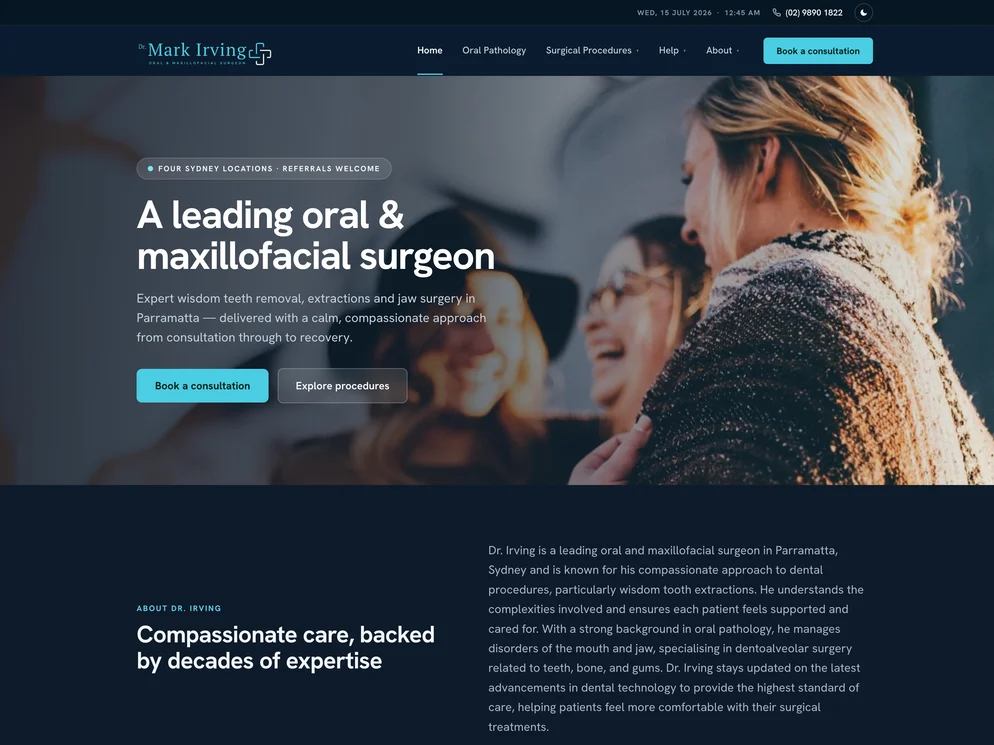
Dr Mark Irving
A specialist surgical practice with almost no search presence. We rebuilt the site around what patients actually search for and fixed the technical problems underneath it. It reached position two on its main search term within six months.
drmarkirving.com.auHawkesbury Motorcycles
A Windsor motorcycle dealership running a legacy system that could not keep the shop floor and the website in agreement. We built the platform underneath it: point of sale, ecommerce, stock, purchasing and customer records working from one set of data, with Xero connected for invoicing.
What we builtJamtable
A retail platform we build and run. Point of sale, ecommerce, stock and customer records working from one set of data, with modules a retailer turns on or leaves off. Multi-tenant, running on Cloudflare Workers, Pages, D1 and R2.
About JamtableEcho
The assistant inside Jamtable. It answers from a retailer’s own catalogue and documents rather than the open web, routes across model providers depending on the question, streams its answers, and runs to a spend ceiling per tenant.
The AI practiceCommunity Library
Street libraries built, painted and installed for areas without easy access to one, then handed to local volunteers to keep stocked.
communitylibrary.com.auDr Mark Irving, in six stages
Not in the copy deck, and kept because it is the only place on this site that shows how a result was reached rather than asserting one.
Meet the client
Ninety minutes. No brief. Briefs describe the website a client thinks they need, which is rarely the business problem they have. We asked which procedure he performs most, where his patients come from, and what happens after a referral. The answer to the last one, that they go home and they search, was the whole business case.
Talk through the problems
Nobody could find him. The platform was the ceiling. The site was slow, and speed is trust. The content described the surgeon instead of answering the patient. There was no conversion path. And structurally, a specialist surgeon was losing surgical searches to general dental clinics with bigger budgets.
Identify the problems worth solving
The stage most agencies skip, because it is where you talk yourself out of billable work. Our filter is one question: does solving this change the number of patients through the door? Three things passed. Own wisdom teeth removal in the catchment. Get off the platform. Answer the patient’s real questions faster than anyone else.
Present a plan
One page, costed and sequenced, with the success criteria written down before a line of code existed, because a plan without a definition of success is a wish. Rebuild custom. Structure the site around procedures rather than the practice. Engineer the technical foundation properly. Build for the pain point. Make every page convert.
Implement
We built it. He went back to operating. Every page is a complete, self-contained answer: impaction, symptoms, the three stages from consultation to follow-up, recovery, and the honest questions about pain and risk. Performance was treated as a feature. Accessibility was built in rather than bolted on with an overlay. The migration lost nothing.
Measure
Claims without receipts are marketing. First page across the procedure set, second position for wisdom teeth removal in the catchment, and scores of 100 in all four Lighthouse categories, inside six months, with no further meetings required from the client.
What we talked him out of, because none of it changed the number of patients through the door:
What went in, and what came out
Claims without receipts are marketing. Both columns are checkable: run the site through Lighthouse yourself.
Asked of the client
- Strategy meetings attended
- 1
- Briefs written
- 0
- Content drafted by the client
- 0
- Design reviews sat through
- 0
- Weekly status calls
- 0
Lighthouse, all four categories
- Performance
- 100
- Accessibility
- 100
- Best Practices
- 100
- SEO
- 100
Hawkesbury Motorcycles
A dealership that has traded at Windsor since 1970, running its whole business on Jamtable.
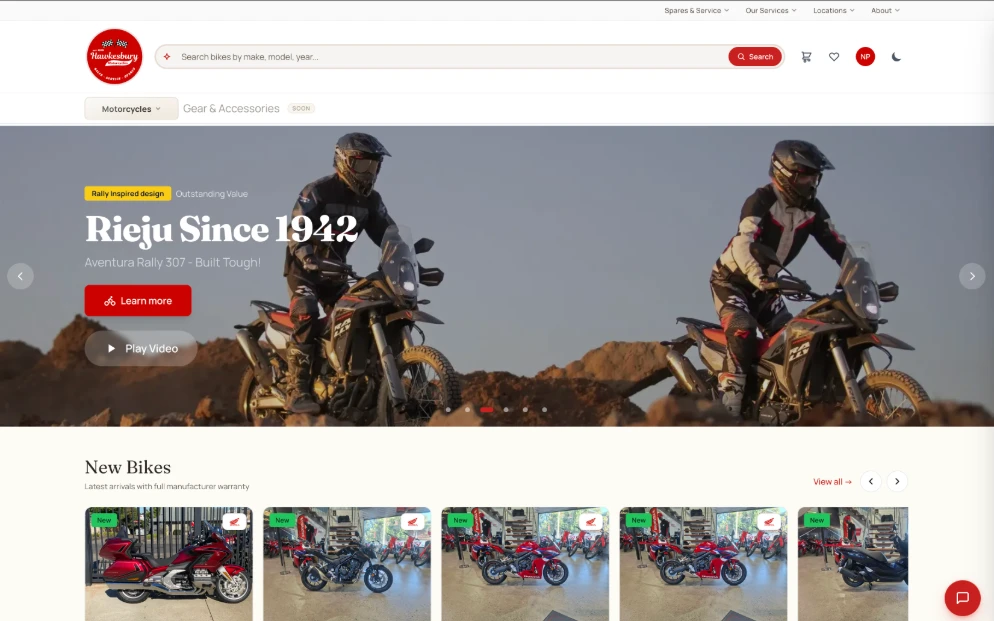
Buy a motorcycle entirely online.
The complete purchase, end to end. Browse live inventory, compare pricing honestly, and secure any bike with a fully refundable holding deposit through Stripe. Pay in full and the bike is prepped for collection or delivery. Finance applications, trade-in valuations and delivery across New South Wales and interstate run inside the same flow rather than four disconnected conversations.
Search that understands riders, not keywords.
Ask for the cheapest LAMS-approved learner bike under eight thousand, or an adventure bike with a low seat height, in ordinary English. The catalogue is tagged by capability rather than by marketing category, so the search answers the question the rider actually asked.
Every bike described, not just listed.
Supplier feeds arrive as fragments. Attributes, categories and descriptions are generated across every make and model, so a catalogue that would take months to write by hand reads consistently from the day it goes up, and the capability tags the search relies on exist for every unit rather than the popular ones.
Written to be found, not padded.
Listing and category copy is generated against what people actually search for, then kept current as stock turns over. A dealership catalogue changes weekly, and copy written once by hand goes stale in the places that matter most.
Priced with the market in view.
Comparable units are gathered and shown against the dealership’s own pricing, so a price is set with the evidence in front of you rather than from memory. The rider sees a straight comparison instead of being asked to go and check for themselves.
Recommendations that know what gets bought together.
Co-purchase intelligence on the storefront and at the counter, so the helmet, the gloves and the pannier rack are offered at the moment they are relevant rather than in an email three days later.
Each order sent the shortest way.
An order is routed on what is actually available and where it sits, rather than defaulting to one location and being unpicked by hand afterwards. The rules live in the platform, so the decision is the same at nine at night as it is at nine in the morning.
On the floor and in the workshop.
Stock, delivery, parts fitment and product questions answered instantly from live data. We also pointed it at a shelf of workshop manuals and turned decades of paper into something a mechanic can hold a conversation with.
Two assistants, and they cannot see each other’s data.
Staff get an assistant with access to the operational side. Riders get one that answers from the catalogue, availability and published content and has no path to customer records or finance data. That is a boundary in the platform rather than an instruction in a prompt, which is what makes putting an assistant on a public storefront reasonable in the first place.
The questions answered without a report request.
Stock, sales, service and web activity are queryable in plain English instead of waiting on an export or a spreadsheet. What gets asked most is itself worth reading, because it shows which answers the business keeps having to go looking for.
One version of the truth.
Point of sale, test rides, purchase orders, supplier feeds, inventory, service, document management, contract signing, deposit-to-settlement payment tracking and finance reconciliation. Personal information is encrypted at rest, contact details are masked by default and revealed deliberately, and exports are protected and logged.
The obligations the Act sets, met by the system that holds the facts.
The dealer register is written from the same records that ran the sale, so the statutory record and the deal cannot drift apart. The dealer guarantee is calculated against the Motor Dealers and Repairers Act 2013 at the point of sale rather than looked up or typed in. Where a sale involves linked credit, the one business day cooling-off period is set on the sale, and the sale cannot progress until it has run or been waived.
Hawkesbury, in eight stages
The order matters more than the list. Most of what went wrong at the start was fixable in a fortnight; what took the time was doing it in a sequence where each part could hold the weight of the next.
What was actually there
A brochure website that could not take a dollar. Stock living in spreadsheets and supplier PDFs. Enquiries landing in a shared inbox where some got answered and some quietly did not. That is not a failing dealership, it is the default, because the software sold to dealerships was built before ecommerce mattered.
The voice came first
Before any of the build, we settled how the dealership sounds, because everything downstream inherits it. Honda, Royal Enfield and Segway all supply good copy written for a national brand rather than a dealer in Windsor. Every piece of it gets reworded rather than pasted. Same facts, dealership’s mouth.
The data model before the features
Every model carries structured attributes, and every physical unit inherits them and adds its own. Getting that right once pays out four times over: the search reads the attributes, the recommendations read them, the statutory sale forms read them, and the assistant reads them. Build the features first and you do this four times, differently.
One way in for supplier data
Price files and stock feeds from three franchises land through a single import layer and come out in one consistent shape, instead of three bespoke messes maintained separately. Images are pulled in, resized and stored on the way through. Nobody uploads four hundred photos by hand.
Every enquiry became a ticket
The customer gets an instant confirmation with a reference. Staff get one dashboard rather than an inbox. Replies thread back into the ticket rather than into somebody’s personal mail. The outcome is boring and valuable: nothing gets lost, and every conversation has a record behind it.
Then it could sell
A rider can secure a bike from their phone at nine at night with a deposit that is held rather than charged, against a deadline, instead of ringing in the morning and hoping. Parts and apparel became things you buy rather than enquire about. Test rides book straight into the diary of the people who run them.
The network, because software cannot outrun the wire
A site-wide wireless network at Windsor: new gateway, new switching, and five access points covering the showroom, the workshop, the offices and the outdoor yard. All active equipment supplied and configured by us, with the physical work done by a licensed electrician.
The audit, and the twelve hours after it
A full production security audit across every login, payment and AI path returned twelve findings. Eleven were closed the same day. The twelfth was assessed and written up as an accepted risk with the reasoning recorded, rather than quietly left. Anyone can commission an audit. What happened next is the part worth judging.
Ask for a reference
If you want to talk to someone we’ve worked with, ask. Introductions are possible where the client is happy to speak.
